Sunday, October 2, 2016

Jason Decrow/Associated Press Audio Reveals What John Kerry Told Syrians Behind Closed Doors


Jason Decrow/Associated Press
BEIRUT, Lebanon — Secretary of State John Kerry was clearly exasperated, not least at his own government.
Over and over again, he complained to a small group of Syrian civilians that his diplomacy had not been backed by a serious threat of military force, according to an audio recording of the meeting obtained by The New York Times.
“I think you’re looking at three people, four people in the administration who have all argued for use of force, and I lost the argument.”
The 40-minute discussion, on the sidelines of last week’s United Nations General Assembly in New York, provides a glimpse of Mr. Kerry’s frustration with his inability to end the Syrian crisis. He veered between voicing sympathy for the Syrians’ frustration with United States policy and trying to justify it.
The conversation took place days after a brief cease-fire he had spearheaded crumbled, and as his Russian counterpart rejected outright his new proposal to stop the bombing of Aleppo. Those setbacks were followed by days of crippling Russian and Syrian airstrikes in Aleppo that the World Health Organization said Wednesday had killed 338 people, including 100 children.
At the meeting last week, Mr. Kerry was trying to explain that the United States has no legal justification for attacking Mr. Assad’s government, whereas Russia was invited in by the government.
“The problem is the Russians don’t care about international law, and we do.”
Mr. Kerry has been hamstrung by Russia’s military operations in Syria and by his inability to persuade Washington to intervene more forcefully. He has also been unable to sell Syrian opponents of Mr. Assad, like the ones in that room, on a policy he does not wholeheartedly believe in.
His frustrations and dissent within the Obama administration have hardly been a secret, but in the recorded conversation, Mr. Kerry lamented being outmaneuvered by the Russians, expressed disagreement with some of Mr. Obama’s policy decisions and said Congress would never agree to use force.
“We’re trying to pursue the diplomacy, and I understand it’s frustrating. You have nobody more frustrated than we are.”
The meeting took place at the Dutch Mission to the United Nations on Sept. 22. There were perhaps 20 people around a table: representatives of four Syrian groups that provide education, rescue and medical services in rebel-held areas; diplomats from three or four countries; and Mr. Kerry’s chief of staff and special envoy for Syria. The recording was made by a non-Syrian attendee, and several other participants confirmed its authenticity.
John Kirby, a State Department spokesman, declined on Thursday evening to comment on what he described as a private conversation. He said that Mr. Kerry was “grateful for the chance to meet with this group of Syrians, to hear their concerns firsthand and to express our continued focus on ending this civil war.”
Several of the Syrian participants said afterward that they had left the meeting demoralized, convinced that no further help would come from the Obama administration. One, a civil engineer named Mustafa Alsyofi, said Mr. Kerry had effectively told the Syrian opposition, “You have to fight for us, but we will not fight for you.”
“How can this be accepted by anyone?” Mr. Alsyofi asked. “It’s unbelievable.”
In the meeting, he and the others pressed Mr. Kerry politely but relentlessly on what they saw as contradictions in American policy. Their comments crystallized the widespread sense of betrayal even among the Syrians most attractive to Washington as potential partners, civilians pushing for pluralistic democracy.
One woman, Marcell Shehwaro, demanded “the bottom line,” asking “how many Syrians” had to be killed to prompt serious action.
“What is the end of it? What he can do that would be the end of it?”
Mr. Kerry responded that “Assad’s indifference to anything” could push the administration to consider new options, adding, “There’s a different conversation taking place” since the intensified bombing of Aleppo and the further breakdown of talks with Russia.
But he also said any further American effort to arm rebels or join the fight could backfire.
“The problem is that, you know, you get, quote, enforcers in there and then everybody ups the ante, right? Russia puts in more, Iran puts in more; Hezbollah is there more and Nusra is more; and Saudi Arabia and Turkey put all their surrogate money in, and you all are destroyed.”
At another point, Mr. Kerry spelled out in stark terms distinctions the United States was making between combatants, which have upset the Syrian opposition: The United States wants the rebels to help it fight the Islamic State and Al Qaeda because, as he put it, “both have basically declared war on us.” But Washington will not join the same rebels in fighting Hezbollah, the Lebanese Shiite militia allied with Mr. Assad, even though the United States lists Hezbollah as a terrorist group like the others.
“Hezbollah,” Mr. Kerry explained, “is not plotting against us.”
He also spoke of the obstacles he faces back home: a Congress unwilling to authorize the use of force and a public tired of war.
“A lot of Americans don’t believe that we should be fighting and sending young Americans over to die in another country.”
One of the Syrians in the room assured Mr. Kerry, “No one is requesting an invasion,” but he insisted that the rebels needed more help.
As time ran short, Mr. Kerry told the Syrians that their best hope was a political solution to bring the opposition into a transitional government. Then, he said, “you can have an election and let the people of Syria decide: Who do they want?”
A State Department official, speaking on the condition of anonymity, said later that Mr. Kerry was not indicating a shift in the administration’s view of Mr. Assad, only reiterating a longstanding belief that he would be ousted in any fair election.
At one point, Mr. Kerry astonished the Syrians at the table when he suggested that they should participate in elections that include President Bashar al-Assad, five years after President Obama demanded that he step down.
Mr. Kerry described the election saying it would be set up by Western and regional powers, and the United Nations, “under the strictest standards.” He said that the millions of Syrians who have fled since the war began in 2011 would be able to participate.
“Everybody who’s registered as a refugee anywhere in the world can vote. Are they going to vote for Assad? Assad’s scared of this happening.”
But the Syrians were skeptical that people living under government rule inside Syria would feel safe casting ballots against Mr. Assad, even with international observers — or that Russia would agree to elections if it could not ensure the outcome. And that is when the conversation reached an impasse, with Ms. Shehwaro, an educator and social media activist, recalling hopes for a more direct American role.
“So you think the only solution is for somebody to come in and get rid of Assad?” Mr. Kerry asked.
“Yes,” Ms. Shehwaro said.
“Who’s that going to be?” he asked. “Who’s going to do that?”
“Three years ago, I would say: You. But right now, I don’t know.”

Saturday, September 3, 2016

اليوم وفي لبنان، المطلوب وقفة تضامن من اللبنانيين المسلمين


اليوم وفي لبنان، المطلوب وقفة تضامن من اللبنانيين المسلمين وخاصة السنة تجاه المسيحيين حتى لا يأتي يوم يكونون فيه هم مستهدفين ولا يجدون احداً يتضامن معهم.
ولكم هذه العبرة من التاريخ:
مارتن نيوملر، رجل دين مسيحي، كتب هذه القصيدة تعليقا على جبن المثقفين الالمان تجاه النازية.
"ًًأولا أتوا للاشتراكيين، وأنا لم أتكلم لأنني لم أكن اشتراكيا.
ثم جاءوا للنقابيين، وأنا لم أتكلم لأنني لم أكن نقابيا.
ثم جاءوا لليهود، وأنا لم أتكلم لأنني لم أكن يهوديا.
ثم أتوا لي ولم يكن أحد متبقي للدفاع عني."
First they came ..." is a famous statement and provocative poem written by Pastor Martin Niemöller (1892–1984) about the cowardice of German intellectuals following the Nazis' rise to power and the subsequent purging of their chosen targets, group after group.
First they came for the Socialists, and I did not speak out—
Because I was not a Socialist.
Then they came for the Trade Unionists, and I did not speak out—
Because I was not a Trade Unionist.
Then they came for the Jews, and I did not speak out—
Because I was not a Jew.
Then they came for me—and there was no one left to speak for me

Tuesday, August 9, 2016

Washington’s Strategic Defeat: Erdogan Trumps Gulenist Coup// By Prof. James Petras Global Research, August 08, 2016


Washington’s Strategic Defeat: Erdogan Trumps Gulenist Coup

Global Research, August 08, 2016
197 
 11 4 
 
 227
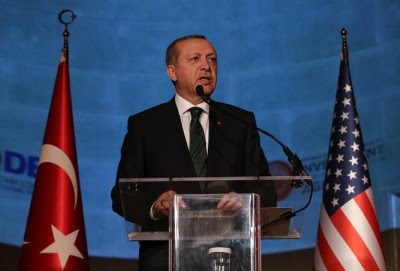
Turkish President Erdogan in USA
For the past decade, the US intelligence agencies operating in Turkey have worked closely with the increasingly influential parallel government of Fethullah Gulen.  Their approach to power was, until recently, a permeationist strategy, of covertly taking over political, economic, administrative, judicial, media, military and cultural positions gradually without resort to elections or military coups. They adopted flexible tactics, supporting and shedding different allies to eliminate rivals.
In 2010 in support of Erdogan, they played a major role in arresting and purging 300 Kemalist – military officials.  Subsequently the Gulenists moved to prosecute and weaken the Erdogan regime via revelations of family corruption uncovered by their intelligence officials and publicized by its mass media outlets.
The Gulenists shared several important policies with Washington which favored “the convergence” that led up to the July 15, 2016 coup.
The Gulenists backed US-Israeli policies in the Middle East; opposed the ‘independent’ and erratic power projections of Erdogan; favored pro-Western free market policies; accepted US relations with the Kurds; rejected any accommodation with the Russians.
In other words, the Gulenists were far more reliable, dependent and subject to the dictates of EU-NATO-US policy throughout the Middle East than the Erdogan regime.
Erdogan was aware of the growing power of the Gulenists and their growing links to Washington.  Erdogan moved decisively  and successfully, to pre-empt the Gulenist power grab by forcing a premature coup.
Erdogan Power Bloc Defeats Gulenist Presence
The Gulenists were a powerful force in the Turkish state and civil society. They had a strong presence in the civil bureaucracy; among sectors of the military, the mass media and educational installations; and among technocrats in the financial agencies.  Yet they were defeated in less than twenty-four hours, because Erdogan had several undeniable strengths.
First and foremost, Erdogan was an unmatched political leader with a strategy to retain power and a powerful active mass popular base.  The Gulenists had nothing comparable.
Erdogan had a superior intelligence and military command which infiltrated and undermined the Gulenists who were totally unprepared for a violent confrontation.
The Gulenists ‘permeationist’ strategy was unprepared and totally incapable of seizing power and mobilizing ‘the street’.
They lacked the cadres and organized grass roots support which Erdogan had built from the bottom-up over the previous two decades.
Erdogan’s insider and outside Islamic-Nationalist strategy was far superior to the Gulenist insider-pro-US liberal strategy.
US Miscalculations in the Coup
The Gulenists depended on US support, which totally miscalculated the relations of power and misread  Erdogan’s capacity to preempt the coup.
The major flaw among the US advisers was their ignorance of the Turkish political equation:  they underestimated Erdogan’s overwhelming party, electoral and mass support.  The CIA overestimated the Gulenists support in their institutional elite structures and underestimated their political isolation in Turkish society.
Moreover, the US military had no sense of the specifications of Turkish political culture – the general popular opposition to a military-bureaucratic takeover.  They failed to recognize that the anti-coup forces included political parties and social movements critical of Erdogan.
The US strategists based the coup on their misreading of the military coups in Egypt, Libya, Iraq and Yemen which ousted nationalist and Islamic civilian regimes.
Erdogan was not vulnerable in the same way as President Mohamed Morsi (June 30, 2012 – July 3, 2013) was in Egypt – he controlled intelligence, military and mass supporters.
The US-Gulenists military intelligence strategy was unplanned, uncoordinated and precipitous – Erdogan’s counter-coup forced their hand and struck decisive, sweeping blows that demoralized the entire Gulenist super-structure.  Thousands of supporters fell like clay pigeons.
The US was put on the defensive – the rapid dissolution of their followers forced them to disown their allies and fall back on general, unconvincing ‘humanitarian’ and ‘security’ criticisms of Erdogan.  Their claims that the Erdogan purge would weaken the fight against ISIS had no influence in Turkey.   Washington’s charges that the arrests were ‘mistreating and abusing’ prisoners had no impact.
The key political fact is that the US backed an uprising which had taken up arms and killed Erdogan loyalist military personel and innocent unarmed civilians opposed to the coup undermined Washington’s feeble protests.
In the end the US even refused refugee status and abandoned their Gulenist General’s to Erdogan’s fate.  Only Fethullah Gulen himself was protected from extradition by his State Department handlers.
Consequences of the US-Gulen Coup
Washington’s failure to bring down Erdogan could have enormous repercussions throughout the Middle East, Western Europe and the United States.
Erdogan ordered seven thousand troops to encircle the strategic NATO airbase in Incirlik, Turkey, an act of intimidation  threatening to undermine NATO’s major nuclear facility and operational base against Syria, Iraq and Russia.
Turkish intelligence and cabinet officials have called into question ongoing political alliances, openly accusing the US military of treason for its role in the coup.
Erdogan has moved to reconcile relations with Russia and has distanced his ties with the European Union.
If Turkey downgrades its ties with NATO, the US would lose its strategic ally on the Southern flank of Russia and undermine its capacity to dominate Syria and Iraq.
Washington’s leverage in Turkey has been dramatically reduced with the decimation of the Gulenist power base in the civilian and military organizations.
Washington may have to rely on the anemic, unstable and servile Syriza – Tsipras regime in Greece to ‘anchor’ its policies in the region.
The failed coup means a major retreat for Washington in the region – and a possible advance for Syria, Iran, Lebanon and Russia.
There are two caveats to this proposition.  After Erdogan ‘completes’ the purge of Gulenists’ and condemns Washington, will he be willing and able to pursue a new independent policy or will he simply tighten internal control and ‘renegotiate’ a NATO agreement?
Will Erdogan consolidate political control over the army or will the defeat of the Gulenists be a temporary outcome which will unleash new military factions which will destabilize the political regime?
Finally, Erdogan depends on Western finance and investment which is highly resistant to backing a regime critical of the US, the EU and NATO.  If Erdogan faces economic pressures from the West can he turn elsewhere or will he, in the face of capitalist ‘realities’ retreat and submit?
Erdogan, temporarily may have defeated a US coup, but history teaches us that new military, political and economic interventions are on Washington’s agenda.

Friday, July 29, 2016

A Civil War Looming in Israel? By Adeyinka Makinde


A Civil War Looming in Israel?

Global Research, July 26, 2016
Adeyinka Makinde 25 July 2016
In-depth Report: PALESTINE
249 
 59 16 
 
 353
israel-1157540_960_720
Amid the seemingly perpetual turbulence and chaos of the Middle East and North Africa comes the warning of a Jewish Civil War:
“We are on the verge of an uprising of hatred, racism, darkness and upcoming killings and assassination based on the overwhelming internal hatred here. We hear hatred at every turn, whether it is directed toward women by military rabbis, by Ashkenazi Jews against Sephardi Jews and Mizrahi Jews against Ashkenazis. This way the seeds of the uprising of hatred are planted, which will lead to a civil war. This hatred is being carried out by the full support and cover of those in charge.” - Isaac Herzog, leader of the opposition Zionist Union coalition in the Israeli Knesset.
Isaac Herzog’s words, spoken on Monday 18th July at a Zionist Camp parliamentary bloc session, may strike the unerring observer as alarmist and even fanciful. How on earth could the people of Israel, a state created in the belief that it would provide the best guarantee for the preservation of the Jewish people, be set on a course of fratricidal conflict which would imperil its existence?
The often repeated warnings of Israel being a state surrounded by a multitude of enemies and which has existed under the perpetual threat of being “driven into the sea” by Arab enemies has seemingly provided the basis of an unbreakable communal solidarity whatever the cultural and ethnic differences between the disparate people that comprise it.  To many, the tendency towards fractiousness and vexation; of episodic disputes and divisions arising within the subtext of an often volatile political discourse only lend credence to the old adage of  “two Jews, three opinions.”
Binyamin Netanyahu was able to ruminate over the slaughter of the ongoing Syrian Civil War as follows: “We will never be like them. We will never lift our hands against our brothers with unfettered enmity.”
The matter of fratricidal conflict is, of course, not unknown to Jewish history. The Book of Judges records a civil war fought between the tribes of Gilead and Ephraim in which over 40,000 lives are claimed to have perished. The Battle of Gibeah pitted the tribes of Israel against that of Benjamin in which 25,000 Benjaminites were slain while the narrative of Hanukkah is one that recounts the violent overthrow of Jewish Hellenists via the Maccabean revolt that was led by Mattathias. The Talmud says that rebellion against the Romans failed because of the “needless enmity between brothers”.
The modern age of Zionism has also provided episodes of violence although they have all fallen short of developing into full-blown communal conflicts. The assassinations of the anti-Zionist Jacob de Haan by the Haganah and Chaim Arlosoroff by Revisionist Zionists in pre-Israel Palestine as well as the murder of Yitzhak Rabin by an orthodox settler extremist in 1995 provide examples of the killings of prominent people which occurred during periods of deep discord.
Israel is not a monolithic society and the divisions of ethnicity as well as those based on religious and political values could provide fertile ground for the development of serious social confrontation.
While the contrasts offered between the Sabra and Diaspora Jews -the former being those who were born within the pre-state Mandate era and the latter those who made Aliyah- is arguably one that was overstated and, perhaps, an often superficial one in the grand scheme of things, divisions within Israeli society are readily discernible from the ethnicities that make it up as well as in the differences between those who are religious and those who are secular.
A starting point of any consideration of fundamental divisions existing within the society can be found in the nature of its constitutional settlement. Israel is one of only three countries in the world that functions without a ‘written’ constitution. One reason for this relates to the compromise reached about the legal status of religion between Israel’s secular founders and the representatives of orthodox Jewry. The ‘Status Quo’ Compromise was an attempt to provide a working arrangement for the role that Judaism would play in the governmental and judicial system. Tensions have existed between secular and religious communities over the decades with one centred on exemptions given to Haredis studying in yeshivas and anti-Zionist Hasidic groups.
There are of course divisions in ideology. Israel was dominated at the time of its founding by Labor Zionists, European Jewish socialists who wanted to develop a state through the manpower of a rural Kibbutzim and an urban proletariat. However, the rise of the Likud Party, which first came to power in 1977, has reflected a shift in the national balance of power to that of the political Right. In the time since elapsed, Likud has held power for a longer period than Labor or other Left parties. Further, Likud’s adoption of neoliberal economic policies in place of earlier ones predicated on a populist orientation has markedly transformed Israeli society -and not necessarily for the better.
For while the Israeli economy, globally renowned for its high-tech component, has experienced continual growth for over a decade, the National Insurance Institute released a report in 2014 detailing a finding that one in five of families in the country live below the poverty line.
Soon after, the Taub Center, an economic and social policy think tank based in Jerusalem issued a state of the nation report which found that four out of five Israeli households spent more than they earned each month. The following year, the National Insurance Institute found that the poverty rate had increased with one in three children living below the poverty line. Israel, which is a member of the Organisation for Economic Cooperation and Development, has the highest level of poverty among developed nations.
Although levels of gross disparities in wealth have often formed the basis for social discord which have led to civil insurrections and revolutions, class conflict as the pathway to an Israeli civil war is unlikely.
For many observers of Israel, the only serious basis of a war breaking out among its population is rooted in the matter of Jewish settlement on the occupied Palestinian West Bank which many believe to be the ancient regions of Judea and Samaria. A survey conducted this year by Israel Democracy Institute’s Guttman Center for Surveys and the University of Tel Aviv found that 71.5 per cent of the Israeli Jewish public did not consider Israel’s presence in the West bank as an occupation. The considered view has long been that the larger in population size these settlements get and the longer they endure, the less likely it increasingly becomes for the settlers to be evicted as part of a final peace settlement with the Palestinians. It has always been understood that any attempt by a serving Israeli government to dislodge the settlers would risk provoking a Jewish Civil War.
While the disengagement from Gaza in 2005 evoked bitter protests and much acrimony on the part of the Israeli political Right, it did not lead to a serious conflict with military overtones. A large scale withdrawal from the more significantly colonised West Bank and dismantling of the settlements  would be an altogether different enterprise. There is evidence that in 1980, Ariel Sharon, by then a retired army general but one with continuing influence, convened a secret meeting of higher echelon figures from the military and security services in which the attendees signed a blood oath under which they pledged to make common cause with settlers on the West Bank in resisting to the death any such move.
The source of the information of such a meeting having taken place came, according to the English journalist Alan Hart, from Ezer Weizman, a former commander of the Israeli Air Force, when he was serving as the minister of defence.
The oath is one which is believed to have been taken by subsequent generations of generals. It strongly underpins the notion that no Israeli Prime Minister could ever countenance the idea of ordering the army to shoot settlers, many of whom among their ranks are permanently armed religious Zionists who would be prepared to initiate an a rebellion.
The threat of a civil war in the Jewish state was a real one in the months soon after its creation in 1948. In fact, bullets were fired and fatalities resulted. The belligerents were the army of the newly created Israeli Defence Force and the terror group, Irgun which was led by Menachem Begin.
Begin, a disciple of Vladimir Jabotinsky who was the creator of New Revisionist Zionism, wanted the nascent Israeli state to continue fighting its Arab neighbours until the whole of Eretz Yisrael was conquered. This included not only the West Bank but the rest of the British Mandate territory that had been east of the River Jordan.
Prime Minister David Ben Gurion preferred not to pursue such a course and demanded that Irgun as with other paramilitary organisations be absorbed into the IDF. Begin resisted this and when his group attempted to bring in a cache of arms from a ship berthed off the coast of Tel Aviv a fierce firefight erupted between both sides leading to 16 Irgun dead and 3 from the IDF.
Begin was the founder of the Likud Party which is merged with Herut, the Right-wing nationalist party he had formed in 1948 to serve as a successor to the defunct Irgun. The formation of Herut was met with great dismay by many Jewish intellectuals including Albert Einstein and Hannah Arendt who took it upon themselves to write an open letter to the New York Times to warn that Israel would head down a path which legitimized “ultranationalism, religious mysticism and racial supremacy”.
Herzog has pointedly blamed the present leadership of Likud, headed by Netanyahu, for allowing the political discourse to slide into a hate filled atmosphere. “This way,” he said, “the seeds of the uprising of hatred are planted, which will lead to a civil war.”
And he is not the only high-ranking Israeli political figure to express profound disquiet at the direction in which Israel is heading. Moshe Yaalon, a former IDF chief of staff resigned as minister for defence after hearing that his position would be offered to Avigdor Lieberman, a hardline figure from the political Right. Yaalon claimed that he was “fearful for Israel’s future”. A few weeks earlier, the deputy chief of the Israeli military, Major General Yair Golan compared contemporary Israel to Nazi Germany of the 1930s.
The rise of Likud, some critics have argued, signified the coming to power of the terror gangs of the Mandate era. And with this they argue has come a more uncompromising position regarding the possibility of a two-state settlement with the Palestinian people. With the expansion of settlements on the West Bank having reached a stage where they are essentially irreversible owing to the certainty of a Jewish Civil War in the event of an attempt to have settlers evicted, the only course left to effect a lasting solution to the ‘Palestinian problem’ is a purge of the Arab population under the cover a serious military conflict with an external enemy.
Herzog’s strongly worded remarks no doubt reflect what many consider to be an entrenched pattern in Netanyahu’s often polarizing and incendiary style. His comments during the last elections regarding the Israeli political Left busing Arab voters “to the polling stations in droves” typified this as did his statements regarding illegal immigrants from Black Africa who he described as “infiltrators” and who he claimed were threatening the “identity of the Jewish state.” Netanyahu’s  rhetoric at a rally in which he criticised Yitzhak Rabin’s efforts at effecting a peace with the Palestinians -one in which people in the crowd held aloft signs bearing Rabin’s image in an SS uniform- is remembered with lasting repulsion by many who consider him at least partly responsible for inciting an atmosphere that led to the assassination of Rabin by Yigal Amir.
It is clear that the statements made by Herzog, Yaalon and Golan point to the increasingly extremist drift of Israeli politics, but whether they reflect a state of affairs capable of metastasizing into an internecine civil conflict remains doubtful. That of course is little comfort for those such as Herzog who observe what he describes as “the budding fascism that is rising and flourishing in Israeli society”; a state of affairs predicted by the aforementioned Einstein and Arendt who had urged American Zionists not to support Begin and what they termed the “latest manifestation of fascism”.
Adeyinka Makinde is a writer based in London, England.